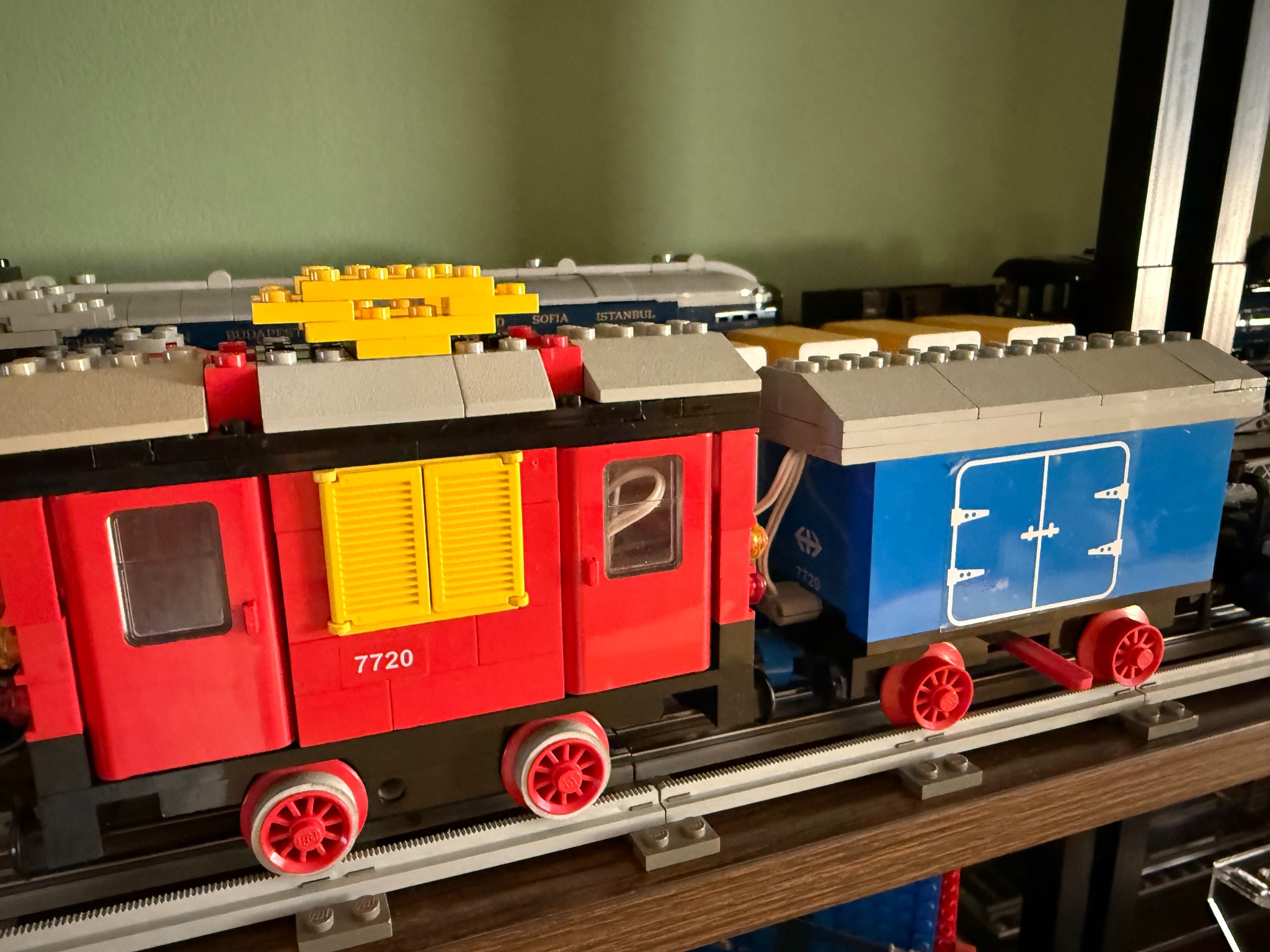
When I think about LEGO trains from the 1980s, the first thing that
comes to mind isn’t a particular set.
It’s a system.
And that is probably the biggest difference compared with what we mean
today when we talk about LEGO trains.
In 1980, LEGO turned trains into a complete product line: locomotives,
passenger and freight trains, coaches, wagons, stations, tracks and an
impressive range of accessories and expansion sets. The old blue
tracks gave way to the new grey track system, beginning what
enthusiasts commonly refer to today as the Grey Era.
But the most interesting thing was that buying a train set didn’t mean
the experience was complete.
That box was simply the starting point.
A System Surprisingly Close to Model Railways
The philosophy was remarkably similar to traditional model railways.
You could start with a simple train that you pushed along the tracks
by hand and later add a 4.5V battery-powered motor.
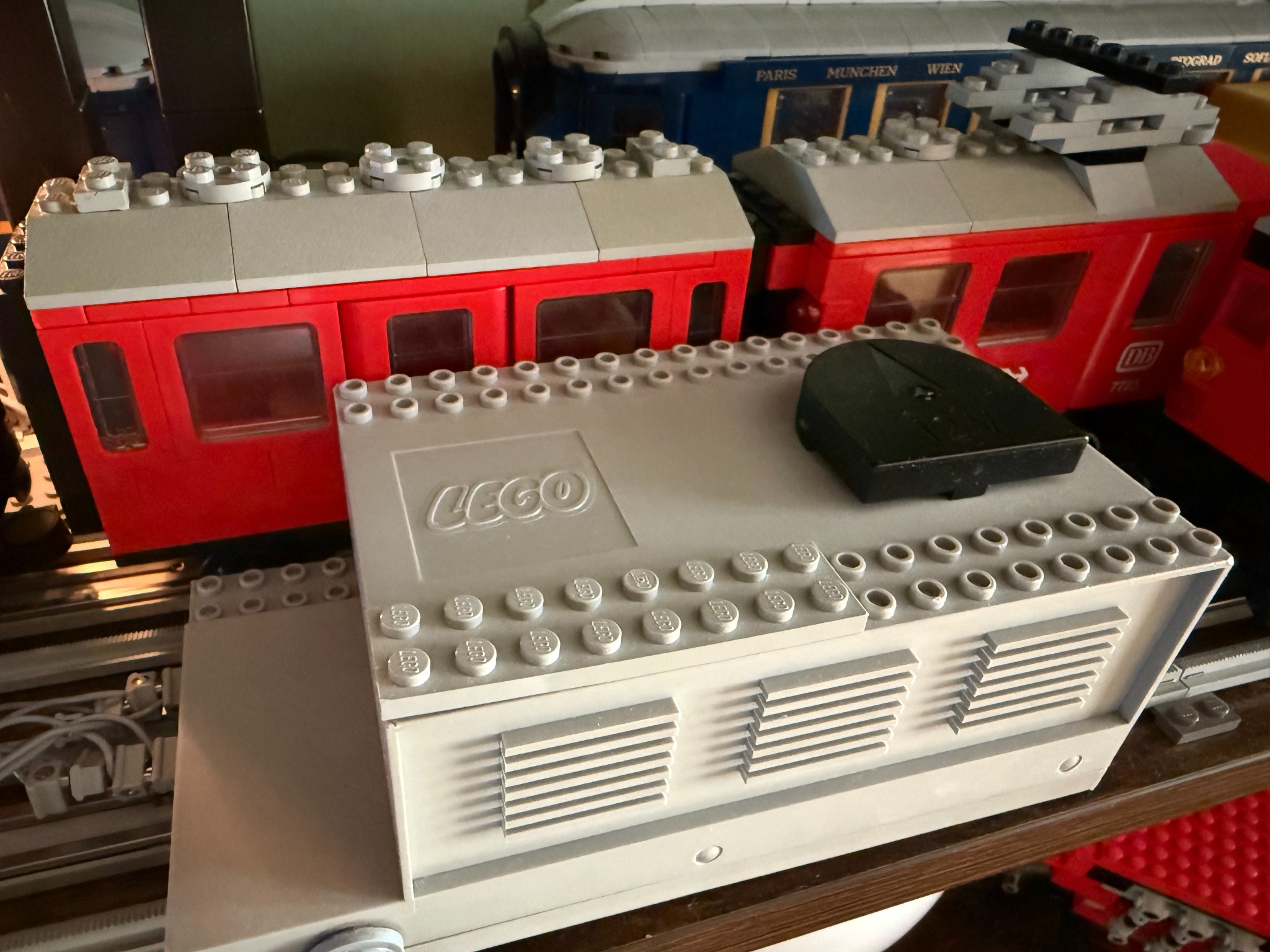
From there, the system could evolve even further to
12V, using a transformer and tracks fitted with
dedicated central conducting rails.
You didn’t necessarily have to replace your train.
You could upgrade what you already had.
And around that train, a complete railway could gradually begin to
take shape.
There were separate packs containing straight and curved tracks,
crossings, points, locomotives and individual wagons, as well as
stations, depots, level crossings and many other accessories.
You could start with a small oval on the floor and gradually transform
it, one piece at a time, into something completely different.
With 12V, the Real Fun Began
The 12V system was probably the closest LEGO ever came to the concept
of a traditional model railway layout.
The transformer wasn’t simply used to control the train’s speed and
direction. It could become the control centre for the entire layout.
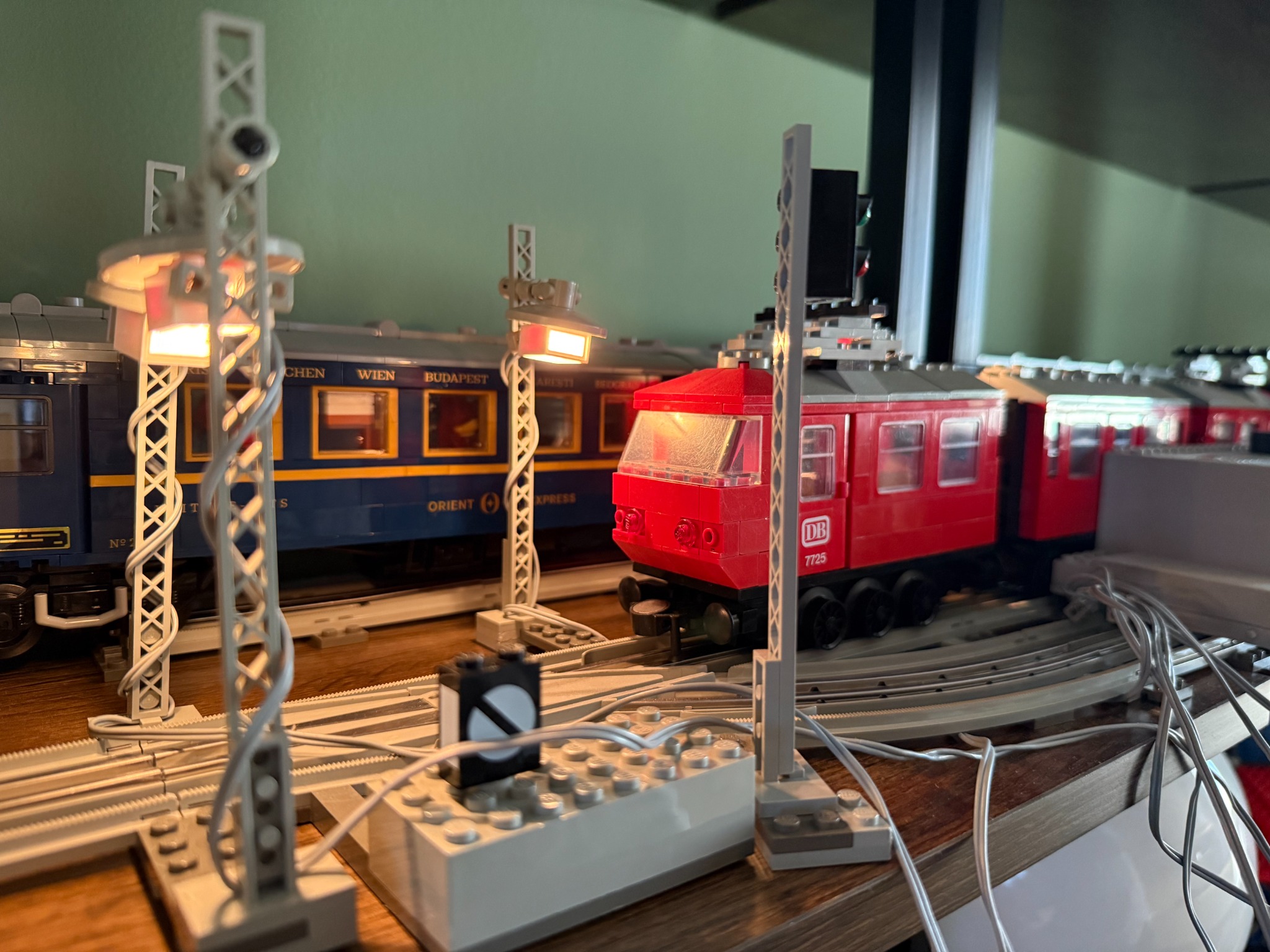
There were electrically operated remote points,
railway signals, level crossings and even a device that allowed you to
uncouple wagons without touching the train.
You could move a train onto a particular track, uncouple a wagon and
start performing actual railway shunting operations.
And the signals weren’t simply decorative.
The system allowed you to create
isolated sections of track: set the signal to red and
power to that section was interrupted, actually stopping the train.
Switch it back to green and the train could continue.
We are talking about LEGO from the early 1980s.
It was basically model railroading.
Only built with bricks.
And of Course, There Were Lights
You could add lighting to the trains, install street lamps alongside
the tracks and illuminate stations and buildings.
And it was precisely those images in the catalogues of the time —
large railway layouts, illuminated stations and long trains — that
made you understand what the real objective was.
Not simply to build a train.
To build a railway.
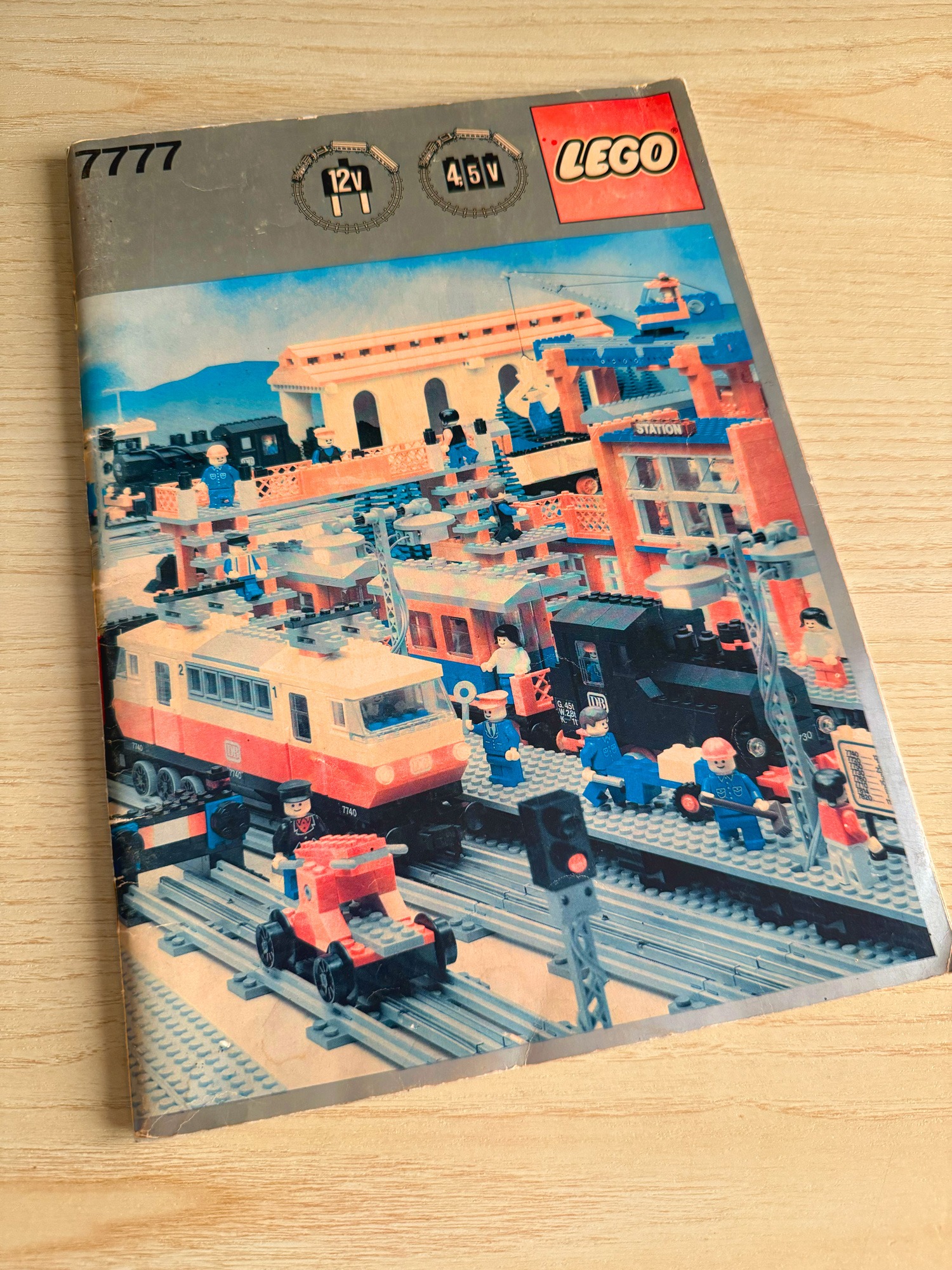
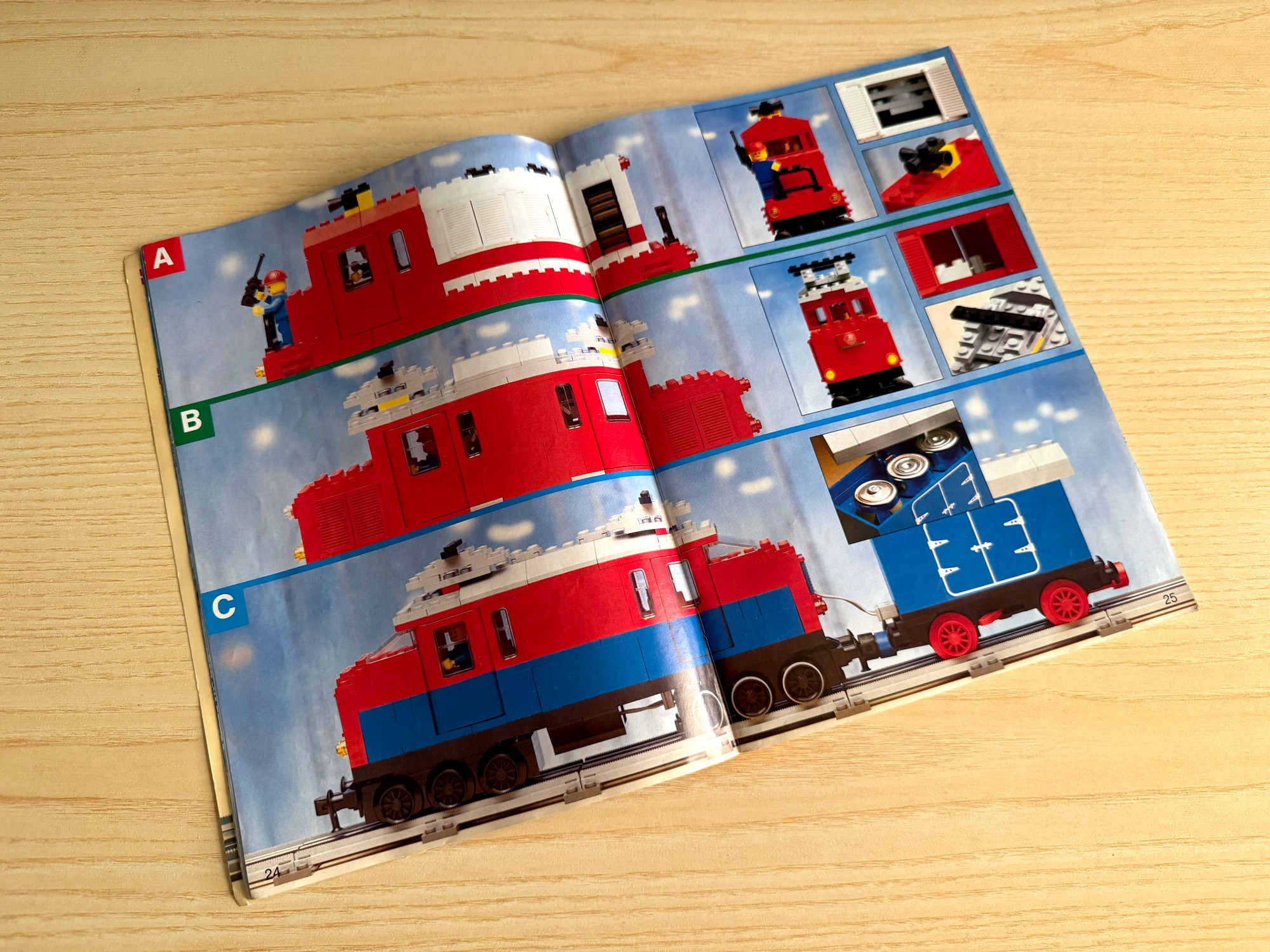
The LEGO Trains Ideas Book 7777
And then there was the LEGO Trains Ideas Book 7777.
For anyone who loves LEGO trains from that period, it has become
something of a cult object.
It didn’t simply show models you could build. It showed what the
system could become if you continued expanding it: stations, depots,
freight yards, bridges, alternative locomotives and, above all,
enormous railway layouts.
It was LEGO’s way of telling you:
“What’s inside the box is only the beginning.”
And that perfectly reflected the philosophy of LEGO System.
An Ecosystem That Grew With You
This is perhaps what I still find most fascinating today. A child
could start with a small manually operated train and let the system
grow over time: first came the battery motor, then perhaps a few more
tracks at Christmas, a set of points, a station and another wagon.
Eventually came the transformer and 12V system, a signal and the
lights.
And after a few years, what had started as a small oval on the floor
could have become a complete LEGO railway layout.
Modern systems are technologically far more advanced: wireless
control, hubs, remote controls and even programming possibilities.
In the 1980s, the technology was analogue, made of wires, electrical
contacts, isolated track sections and switches.
But the ecosystem itself was incredibly rich.
And that is probably an important part of why I still love LEGO trains
from that period so much.
Not because every individual train was necessarily better than today’s
models.
But because behind every train there seemed to be
an entire world just waiting to be built.
In the 1980s, LEGO wasn’t simply selling you a train. It was selling you the first piece of your railway.
Quando i treni LEGO erano un vero sistema ferroviario
Se penso ai treni LEGO degli anni ’80, la prima cosa che mi viene in
mente non è un singolo set.
È un sistema.
Ed è probabilmente questa la differenza più grande rispetto a quello
che intendiamo oggi quando parliamo di treni LEGO.
Nel 1980 LEGO trasformò i treni in una vera linea di prodotto
autonoma: locomotive, convogli passeggeri e merci, carrozze, vagoni,
stazioni, binari e una quantità impressionante di accessori ed
espansioni. I vecchi binari blu lasciarono il posto ai nuovi binari
grigi e iniziò quella che gli appassionati oggi chiamano comunemente
Grey Era.
Ma la cosa più interessante è che non eri obbligato a comprare un
treno e considerare l’esperienza conclusa.
Quella scatola era semplicemente
il punto di partenza.
Un sistema molto vicino al ferromodellismo
La filosofia era sorprendentemente simile a quella del ferromodellismo
tradizionale.
Potevi iniziare con un semplice treno da spingere a mano e
successivamente aggiungere un motore alimentato a batterie a
4,5 V. Da lì il sistema poteva crescere ulteriormente
fino ad arrivare al 12 V, con trasformatore e binari
dotati degli appositi elementi conduttori centrali.
Non dovevi necessariamente cambiare treno.
Potevi far evolvere quello che già possedevi.
E intorno al convoglio poteva progressivamente nascere una vera
ferrovia.
Esistevano confezioni con binari dritti e curvi, incroci, scambi,
locomotive e vagoni venduti separatamente, stazioni, depositi,
passaggi a livello e tantissimi altri accessori.
Potevi quindi iniziare con un piccolo ovale sul pavimento e
trasformarlo, un pezzo alla volta, in qualcosa di completamente
diverso.
Con il 12 V iniziava il divertimento vero
Il sistema 12 V rappresenta probabilmente il momento in cui LEGO si è
avvicinata maggiormente al concetto di
plastico ferroviario tradizionale.
Il trasformatore non serviva soltanto per regolare velocità e
direzione del treno: poteva diventare il centro di comando dell’intero
impianto.
Esistevano
scambi comandabili elettricamente a distanza, segnali
ferroviari, passaggi a livello e persino un dispositivo che permetteva
di sganciare i vagoni senza toccare il convoglio.
Potevi portare un treno su un determinato binario, sganciare un carro
e iniziare a fare vere manovre ferroviarie.
E i semafori non erano semplicemente decorativi.
Il sistema permetteva di creare
sezioni isolate del tracciato: mettendo il segnale
sul rosso veniva interrotta l’alimentazione di quel tratto e il treno
si fermava realmente. Passando al verde poteva ripartire.
Stiamo parlando di LEGO dei primi anni ’80.
Era praticamente ferromodellismo.
Solo fatto con i mattoncini.
E naturalmente c’erano le luci
Potevi aggiungere illuminazione ai convogli, installare lampioni lungo
i binari e illuminare stazioni ed edifici.
Ed erano proprio le immagini dei cataloghi dell’epoca, con grandi
impianti ferroviari, stazioni illuminate e lunghi convogli, a farti
capire quale fosse l’obiettivo.
Non costruire semplicemente un treno.
Costruire una ferrovia.
Il LEGO Ideas Book 7777
E poi c’era lui: il LEGO Trains Ideas Book 7777.
Per chi ama i treni LEGO di quell’epoca è praticamente un oggetto di
culto.
Non mostrava soltanto dei modelli da costruire, ma quello che il
sistema avrebbe potuto diventare continuando ad ampliarlo: stazioni,
depositi, scali merci, ponti, locomotive alternative e soprattutto
enormi plastici ferroviari.
Era il modo LEGO di dirti:
“Quello che c’è nella scatola è soltanto l’inizio.”
Ed era perfettamente coerente con la filosofia LEGO System.
Un ecosistema che cresceva insieme a te
Questa è forse la cosa che trovo più affascinante ancora oggi. Un
bambino poteva iniziare con un piccolo treno manuale e farlo crescere
nel tempo: prima il motore a batterie, poi qualche binario in più
ricevuto magari a Natale, uno scambio, una stazione e un altro vagone.
Infine arrivavano il trasformatore e il sistema 12 V, un segnale e le
luci.
E dopo qualche anno quello che era nato come un piccolo ovale sul
pavimento poteva essere diventato
un vero impianto ferroviario LEGO.
I sistemi moderni sono tecnologicamente molto più evoluti: controllo
wireless, hub, telecomandi e possibilità di programmazione.
Negli anni ’80 la tecnologia era analogica, fatta di fili, contatti
elettrici, sezioni di binario e pulsanti.
Ma l’ecosistema era incredibilmente ricco.
Ed è probabilmente una parte importante del motivo per cui continuo ad
amare così tanto i treni LEGO di quell’epoca.
Non perché ogni singolo modello fosse necessariamente migliore di
quelli moderni.
Ma perché dietro ogni treno sembrava esserci
un mondo intero che aspettava soltanto di essere costruito.
Negli anni ’80 LEGO non ti vendeva semplicemente un treno. Ti vendeva il primo pezzo della tua ferrovia.