IDEAS / 21360 · 2025
LEGO® Willy Wonka & the Chocolate Factory
An explosion of colour, detail and imagination
There are LEGO® sets you build. And then there are sets that, brick by brick, manage to transport you into another world.
Willy Wonka & the Chocolate Factory definitely belongs to the second category.
I had already seen the model in person before building it, so aesthetically I more or less knew what to expect. What I did not know was the building experience. And it was precisely while putting it together that I realised how much more complex, rich and interesting this LEGO® Ideas set is than it may appear in photographs.
I also continue to maintain one thing: for me, this could easily be considered a Christmas set. Willy Wonka belongs to that kind of fantasy imagery which, at least for my generation, is also connected with films that regularly returned to television during the holidays. Colour, sweets, imagination and nostalgia: practically all the ingredients are there.
Before the bricks, there was Willy Wonka
The story naturally began with Roald Dahl’s novel Charlie and the Chocolate Factory, published in 1964.
Dahl said that he had also drawn inspiration from childhood memories, when British confectionery companies sent products to schools for children to taste and review. It was a world of closely guarded recipes, experiments and competition that helped inspire the mysterious world of Willy Wonka’s factory.
The first film adaptation arrived in 1971, with Gene Wilder as Wonka. This is the version to which I feel most attached: having been born in the 1970s, it belongs to that category of films that regularly reappeared on television throughout the 1980s.
It is very much a product of its time, with sets and atmospheres that today may even vaguely recall The Wizard of Oz, but it still has an extraordinary charm.
In 2005 came the version directed by Tim Burton, starring Johnny Depp. Very different, considerably darker and at times almost unsettling, but also extremely fascinating and, in several respects, closer to the spirit of the novel.
Finally, we had Wonka, which chose not to retell Charlie’s story but instead took the prequel route, focusing on the character’s youth.
Three very different interpretations of the same universe. And it is interesting to see how each one also reflects the period in which it was made.
But now, let’s get to the bricks.
A diorama that tells an entire world
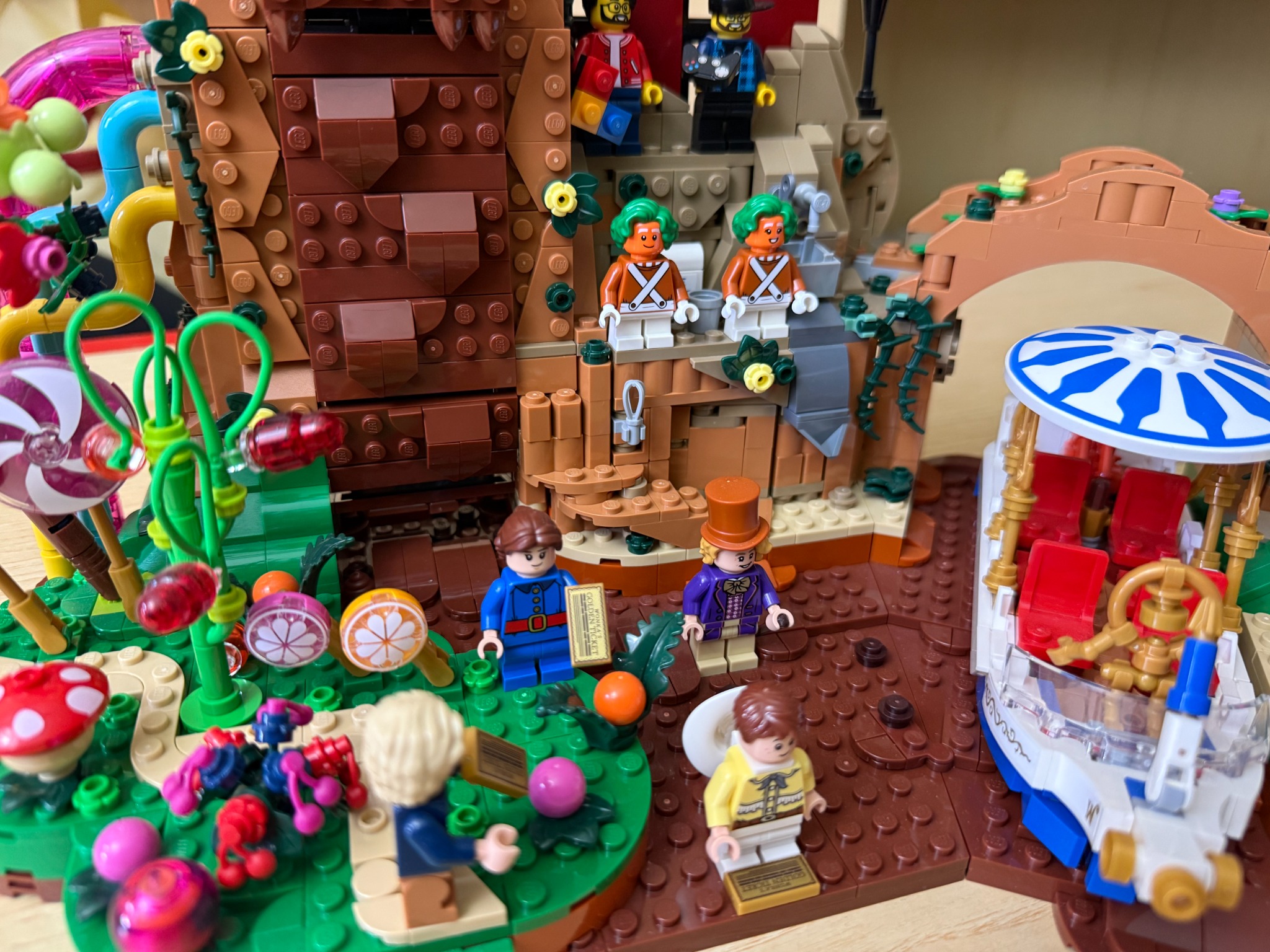
The first thing that strikes you about the completed set is the impressive number of elements the designers managed to concentrate into a relatively compact space.
This is not simply “the chocolate factory”.
It is a true three-dimensional diorama, developed across several levels, where vegetation, structures, pipes, trees, mushrooms, sweets, scenic elements and, of course, the inevitable chocolate river all coexist.
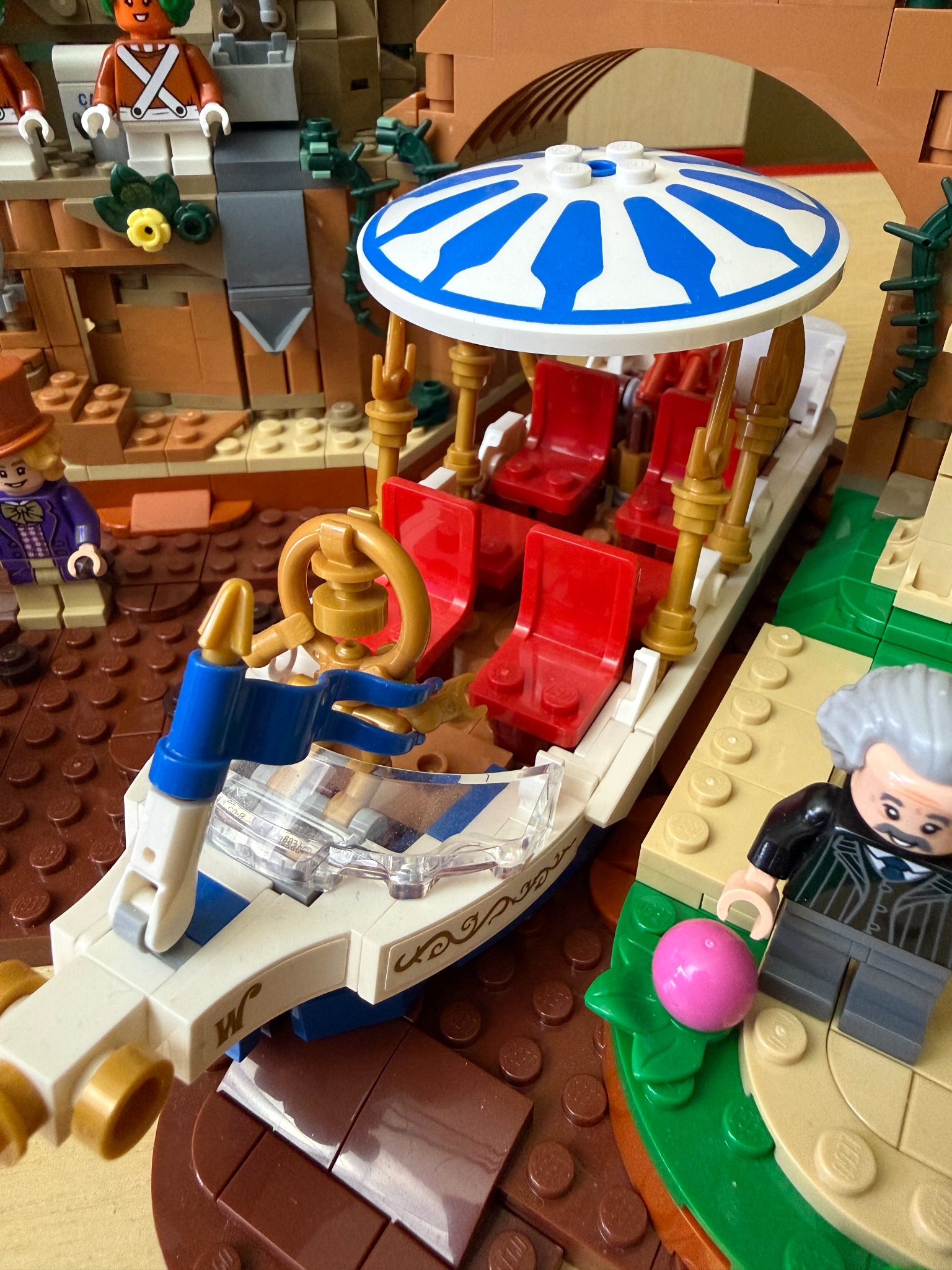
There is even the famous boat used to carry visitors through the factory, which could easily be considered a small set within the set.
The base initially relies mainly on natural shades: dark brown, brown and green. During the first stages of the build, you are therefore faced with a relatively restrained and highly layered structure.
Then something happens.
As the build continues, colour begins to appear everywhere.
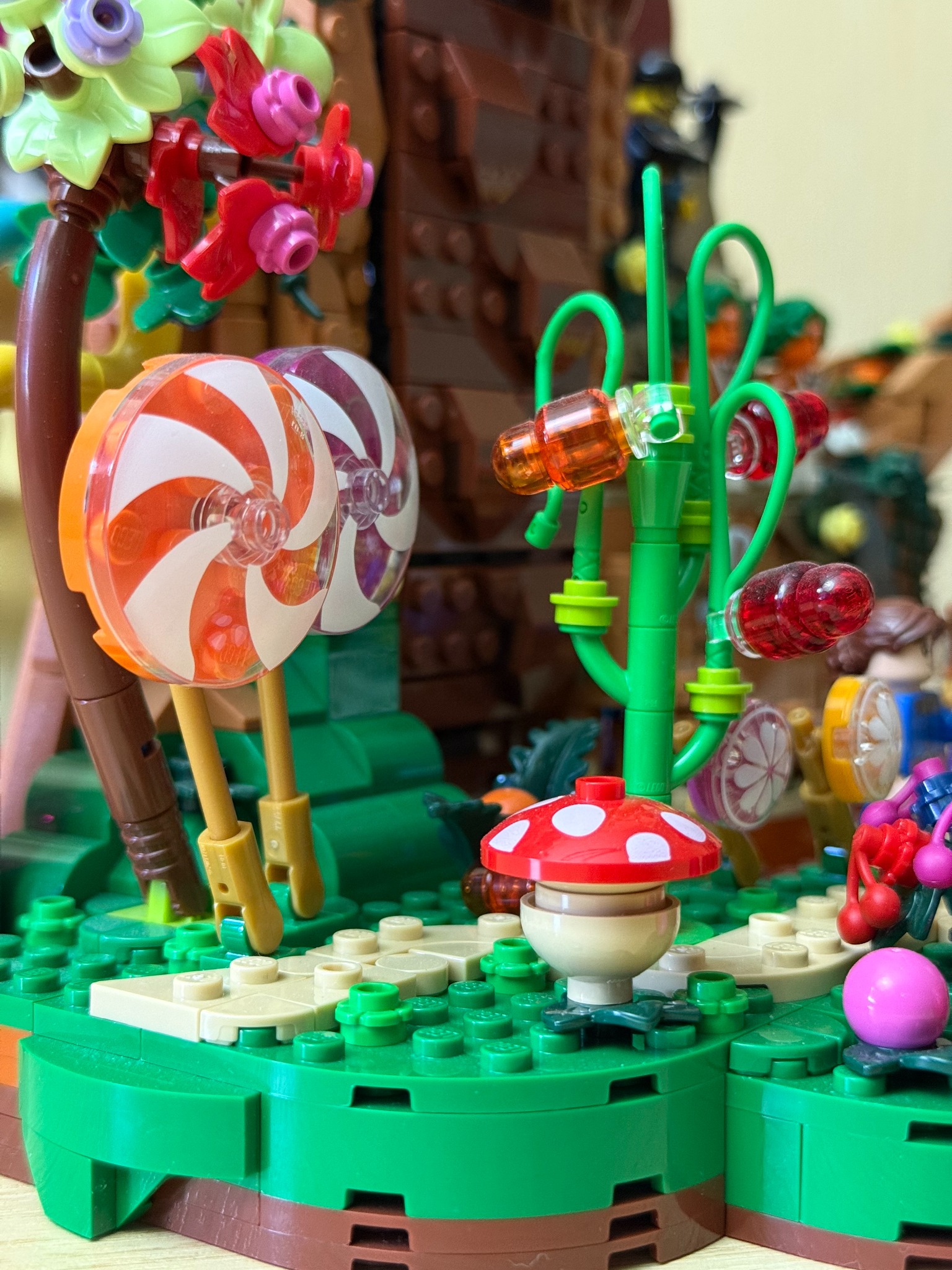
Pink, purple, yellow, red, green and light blue. Small elements gradually transform that almost monochromatic base into a kind of gigantic explosion of sweets.
And this, in my opinion, is where the model is at its best.
Colour is part of the design
Using lots of colours does not automatically produce a beautiful model.
Quite the opposite.
The more colours you introduce into a build, the harder it becomes to maintain visual balance without turning everything into a confusing mess.
Here, however, the work is remarkable.
Each area has its own identity, and even apparently secondary elements — trees, plants, mushrooms and pipes — are built using different combinations.
During the build, you realise that behind this apparent chromatic madness there is actually a very precise study of colour.
The result is harmonious, entertaining and, above all, perfectly consistent with the world of Willy Wonka.
One small side effect: building it gave me an overwhelming urge to eat sweets, chocolate and every other sugary bit of junk within reach.
You have been warned.
A build that is anything but simple
Do not be fooled by its playful appearance.
This is not a particularly easy set to build.
Much of the model consists of very small elements, often 1x1 pieces and equally tiny variations, which require considerable attention.
I personally had to go back through a few steps after realising that I had placed some elements in the wrong position.
It is therefore one of those sets I recommend building calmly, without rushing and preferably when you are reasonably well rested.
In return, it is also a small masterclass in building techniques.
The irregular terrain, curves, different levels and organic structures require a wide variety of solutions.
And, as is increasingly common even in System sets, several LEGO® Technic components are used to achieve movements, connections or geometries that would be difficult to create using traditional elements alone.
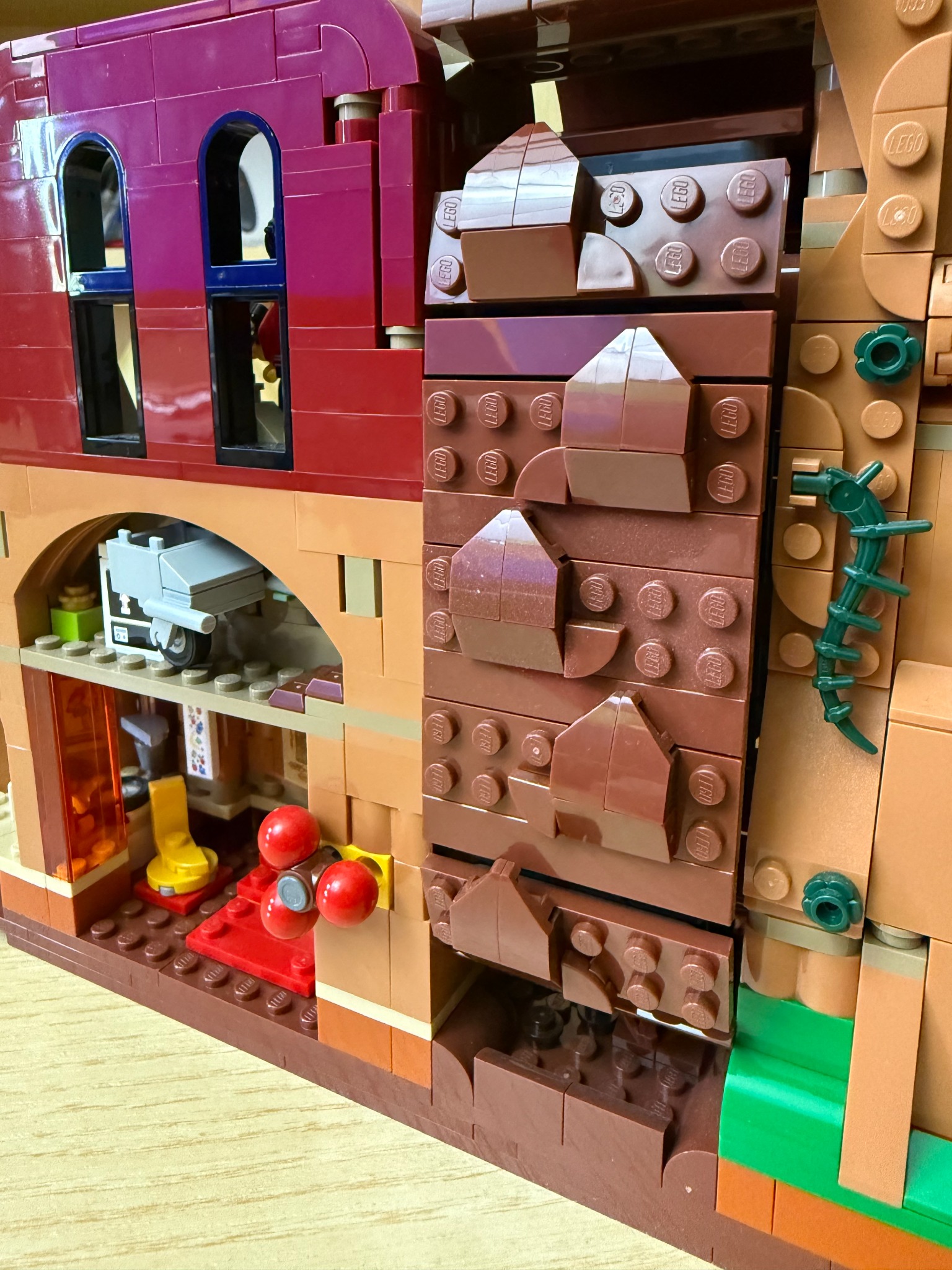
Beneath the waterfall, for example, part of the mechanism that animates the model is concealed.
As far as I am concerned, this crossover between System and Technic is absolutely welcome: if a component makes a certain function possible, why not use it?
Instructions: there was room for improvement
If I have to identify a genuine flaw in the building experience, it concerns the instructions.
In a few steps, the perspective view of the model does not make it immediately clear where certain small elements should be positioned.
When working with tiny pieces inside such a dense build, an additional top view would have helped considerably.
The model is also rotated many times during construction and, considering the number of details, some steps end up demanding more attention than necessary.
Of course, that might also be the fault of my advancing age…
But in my opinion, a few additional views would have made the build more immediate.
A detail inside another detail
The extraordinary thing is that the more you look at the model, the more new details you discover.
There are almost hidden areas, tiny rooms, signs, accessories and even a genuinely functioning lens incorporated into one of the elements.
And this is probably the feature that surprised me the most.
I expected a spectacular display model.
I did not expect this density of detail.
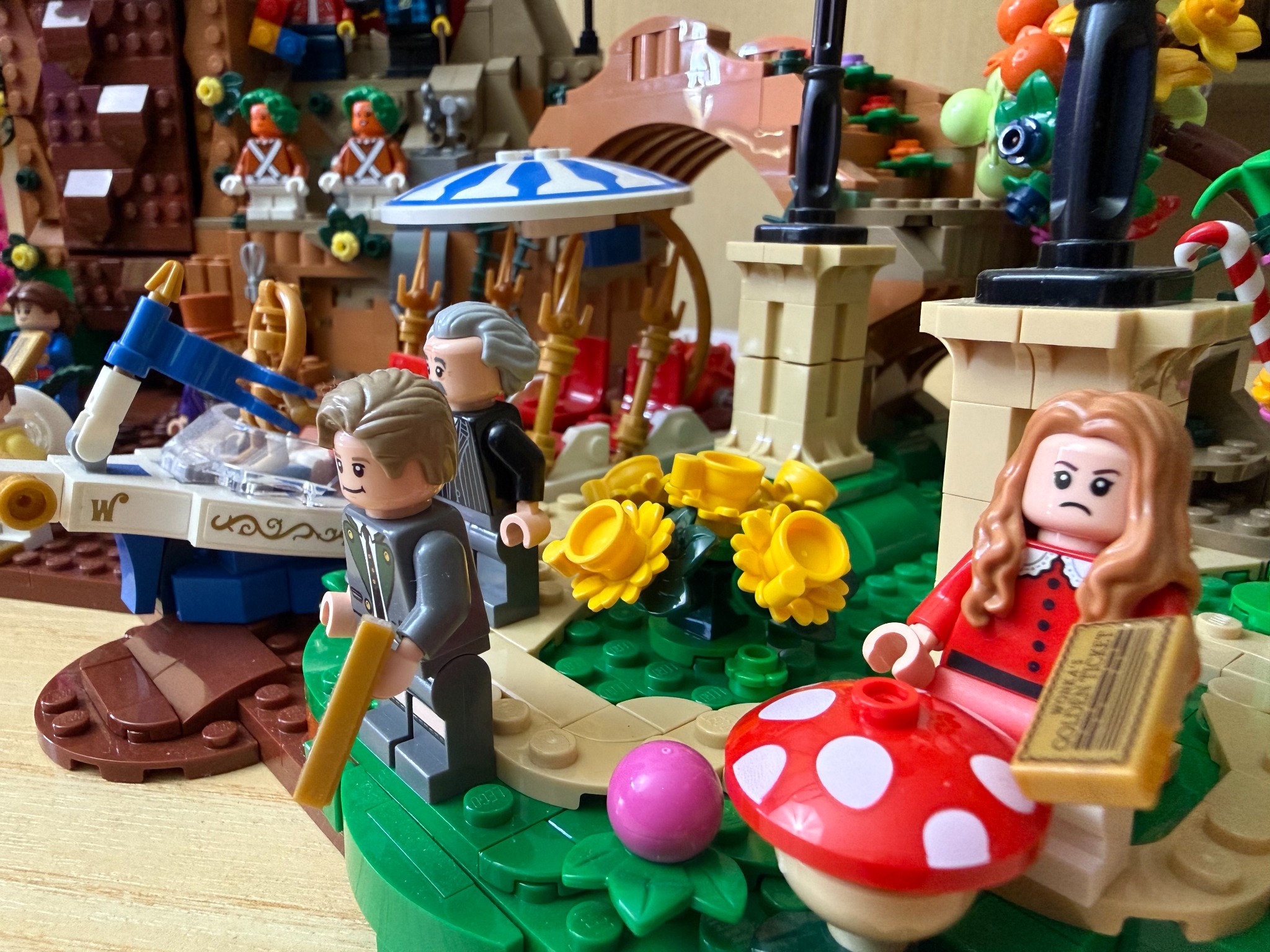
Fortunately, many of the most important elements are printed. Even the famous Golden Tickets held by the minifigures are decorated elements and do not require stickers.
There are still stickers.
Not many, but I have to admit that on a set of this level I would have preferred exclusively printed elements. The stickers are mainly used to enrich the boat and a few small factory details and, fortunately, the model would remain extremely rich even without applying them.
The minifigures and the boat
The set includes numerous characters that allow you to recreate the most recognisable scenes from the story, including, of course, the Oompa Loompas, made using the non-articulated short legs.
But the boat deserves a special mention.
It is beautiful.
Packed with detail, complete with paddles and perfectly integrated into the diorama, it has enough presence to feel almost like a small independent model.
It is one of those elements that demonstrates how important it was, when designing the set, not to limit the project to simply building a backdrop.
What if we motorised it?
Naturally, I could not resist.
I tried to motorise the model.
This is not a feature included in the instructions, but it is relatively simple to achieve: in my case I temporarily removed the entrance steps and inserted a motor connected through a transmission and reduction gearing.
There is only one piece of advice: run it slowly.
Excessive speed not only looks unrealistic, but also greatly increases noise and stress on the mechanism.
It remains an interesting experiment and once again shows how well this model lends itself to customisation.
The chocolate waterfall: a good idea, but less convincing in execution
If I have to choose the detail that convinces me least aesthetically, it is the chocolate waterfall.
I completely understand the challenge: reproducing a liquid, organic substance in motion using LEGO® elements is extremely difficult.
There probably is not even a truly perfect solution.
Looking at it, however, this is the part that least conveys the sensation of melted chocolate, especially compared with how successfully the rest of the model evokes the film’s environment.
We are, however, really splitting hairs here.
A set I would love to see illuminated
Finally, there is one thing this model made me think once again: LEGO® should seriously consider integrated lighting for sets aimed at adults.
Just imagine it.
The lamps switched on, transparent parts illuminated, niches, pipes and the different factory elements emerging from the darkness.
A model like this would take on a completely different personality.
Third-party kits naturally exist, but they almost always involve a large number of very thin wires that have to be hidden inside the build.
I would love to see LEGO® eventually create a system genuinely designed to integrate lighting directly into the design of its models.
On a set like this, it would be spectacular.
Conclusions
I have to admit it: I expected much less.
I thought I would find a nice LEGO® Ideas set — colourful, entertaining and, above all, connected to an iconic film.
Instead, I found an extremely refined, complex and surprisingly technical model.
The build requires time and attention, but that is precisely what makes it so rewarding. It is full of interesting little techniques, intelligently combines System and Technic elements and, above all, manages to maintain remarkable chromatic balance despite the enormous number of colours involved.
The flaws?
The instructions could have been clearer in a few places, I would have preferred a few more printed elements instead of stickers, and the chocolate waterfall is probably the part that convinces me least aesthetically.
But these are genuinely minor observations compared with the overall quality of the model.
And perhaps the most interesting thing is that I do not think you need to be a die-hard Willy Wonka fan to appreciate it.
If you know the films, naturally discovering all the references makes the experience even more enjoyable. But even considered simply as a LEGO® model, it remains an exceptionally rich, technically interesting build and, above all, something very different from almost anything normally found on store shelves.
For me, it is also one of those perfect sets to build slowly during the Christmas holidays.
It is cold outside, perhaps already dark, there is a mountain of colourful bricks on the table and, in front of you, the Chocolate Factory takes shape one piece at a time.
If possible, keep the bag of sweets at a safe distance.
Because by the time you reach the halfway point of the build, it may already be too late.
← ARCHIVE